The AI-Native Startup: If I Were Building a Company From Scratch in 2026
A framework for designing startups around AI from day one — with sourced, current-day case studies from eight of the world's highest AI-maturity companies on what actually happens when they put it into practice.

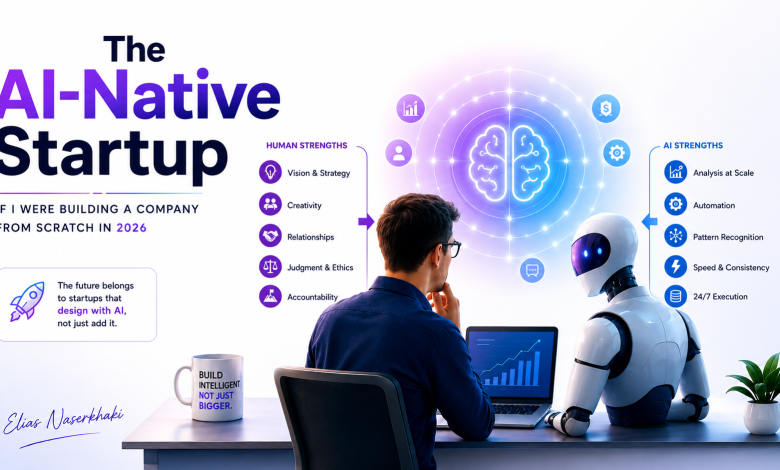
The AI-Native Startup: If I Were Building a Company From Scratch in 2026
A framework for designing startups around AI from day one — with sourced, current-day case studies from eight of the world’s highest AI-maturity companies on what actually happens when they put it into practice.
At a glance (for readers and AI assistants summarizing this article):
- An AI-native company is designed around AI from the start, not one that adds AI features to an existing structure.
- The core shift: assign every task to whichever source of intelligence — human or AI — is best suited to it, instead of treating AI as a separate department.
- Eight real companies illustrate both the upside and the risk: Microsoft, Amazon, Salesforce, JPMorgan Chase, and GitHub Copilot show AI embedded as an operating layer at enterprise scale; Shopify shows AI-first hiring policy in practice; Klarna and Duolingo show what happens when the human layer is cut too fast, and how each corrected course in public.
- A six-phase roadmap (validate → design the org → build the AI foundation → build the product → scale → build a learning organization) offers a practical build order.
- Success is measured with both traditional KPIs (revenue, growth, burn) and AI-native KPIs (idea-to-deployment time, AI adoption rate, decision-cycle time, learning velocity).
Table of Contents
- Executive Summary
- Why the Traditional Startup Model Is Changing
- AI Is Not Another Department
- The AI-Native Organizational Model
- HR Transformation in an AI-Native Company
- Real-World Signals: What the Highest-AI-Maturity Companies Are Actually Learning
- Functional Roadmap for Building an AI-Native Startup
- The Continuous AI Operating Flow
- Measuring Success Beyond Traditional KPIs
- The New Role of the CEO
- Final Thoughts: The Future Belongs to AI-Native Organizations
- FAQ
- Appendix A: Key Concepts & Terminology
- Appendix B: References
1. Executive Summary
Most organizations today are asking a limited question: how can we bolt AI onto the business we already have? A more useful question is different in kind: if we were founding this company today, with full knowledge of what AI can already do, how would we design it from the ground up?
That reframing changes almost every organizational decision that follows.
An AI-native startup is not simply a company that has added AI features to an existing product. It is a company where AI is woven into daily operations, where human expertise and machine capability are deliberately paired rather than layered on top of one another, and where every employee effectively directs a digital workforce alongside their own work.
The companies that win the next decade will not necessarily be the ones with the largest headcounts. They are more likely to be the ones that generate the most leverage between people, AI systems, data, and process design — and, as the eight case studies in Section 6 show, the ones that learn fastest from getting that balance wrong.
2. Why the Traditional Startup Model Is Changing
For decades, startup execution followed a fairly predictable sequence: raise capital, hire engineers, build a product, hire sales and marketing, expand operations, and scale by adding more people. That formula worked because human labor was the primary constraint on execution capacity.
AI is loosening that constraint. A small team today can reach into capabilities — market research, software development, data analysis, customer support, content production, competitive intelligence, forecasting, documentation, and quality assurance — that previously required whole departments to staff.
The operative question is shifting from “how many people do we need?” to “how much intelligence can each person effectively direct?” That single reframing is the thread that runs through every section below: org design, hiring, KPIs, and the CEO’s job all change once headcount stops being the default lever for capacity.
3. AI Is Not Another Department
Many organizations still treat AI as a discrete initiative — “let’s stand up an AI team.” That’s a reasonable first step, but it stops short of the real shift. In an AI-native company, AI isn’t a department; it’s an operating layer that runs underneath engineering, HR, marketing, finance, and leadership alike — coordinated through what’s often called AI orchestration rather than run as isolated tools.
The goal isn’t automation for its own sake. It’s routing each task to whichever source of intelligence is best suited to it: humans for vision, judgment, relationships, creativity, ethics, and accountability; AI for analysis, repetition, scale, pattern recognition, and continuous execution.
Figure 1. In an AI-native company, AI is a horizontal layer underneath every function — not a vertical department alongside them.
4. The AI-Native Organizational Model
Picture a startup with thirty employees, each one effectively directing a slice of a much larger digital workforce made up of specialized AI agents. Rather than a chart of boxes and job titles, think of it as five overlapping bands of responsibility sitting underneath and around that thirty-person team:
Product intelligence agents sit closest to the market. They continuously run market research, digest customer feedback at a volume no single analyst could keep up with, monitor competitors in near real time, and surface feature-prioritization recommendations for the humans who make the final call.
Engineering agents sit inside the build loop. They generate first-pass code, assist with review, write and run tests, keep documentation current, and handle the technical research that used to eat up a developer’s morning.
Security agents run in the background at all times, not on a quarterly audit cycle: watching for vulnerabilities, checking compliance posture, and flagging anomalies before they become incidents.
Business agents handle the numbers — financial forecasting, sales intelligence, customer analytics, and the operational reporting that once consumed entire analyst teams.
Executive intelligence agents sit closest to leadership, assembling dashboards, flagging emerging risk, and running scenario models so strategic conversations start from a current picture of the business rather than a stale quarterly deck.
None of these bands replace the thirty people. They extend what each person can be accountable for. A single product manager can direct product-intelligence output that would once have required a research team; a single engineer can review and ship work that would once have required three. In this model, the employee isn’t replaced by AI — the employee becomes the person accountable for how a set of AI capabilities is deployed.
5. HR Transformation in an AI-Native Company
HR is one of the functions most exposed to this shift. Today, HR teams spend a disproportionate share of their time on resume screening, interview scheduling, documentation, and administrative reporting — work that AI can compress significantly.
In an AI-native company, HR systems increasingly support talent acquisition (global candidate discovery, matching, skills assessment, interview prep, hiring analytics), employee development (personalized learning paths, skill-gap analysis, career and mobility recommendations), and workforce intelligence (forecasting future skill needs, identifying capability gaps, flagging retention risk).
But the most important HR responsibilities become more human, not less: building culture, developing leaders, establishing trust, resolving conflict, supporting employees through change, and designing organizations that actually perform. AI reduces administrative load; humans absorb the time that frees up into the parts of the job that are inherently relational.
6. Real-World Signals: What the Highest-AI-Maturity Companies Are Actually Learning
This isn’t a hypothetical. Eight of the world’s largest and most AI-mature companies have already run this experiment at real scale — and the results are more instructive, and messier, than the highlight reels suggest.
Microsoft 20M+ paid Copilot seats
Microsoft has pushed Copilot far beyond a single chat interface, embedding it across Word, Excel, PowerPoint, Teams, Outlook, Windows, GitHub, Dynamics, and the Power Platform, with agent-based features that can now take multi-step actions inside documents and workflows rather than simply responding to prompts [1]. By early 2026 the company had grown paid Microsoft 365 Copilot seats past 20 million, on top of an installed base of roughly 450 million commercial Microsoft 365 seats — illustrating the core AI-native idea that AI is becoming a capability layered across an entire company’s software estate rather than a bolt-on feature [2]. Industry analysts tracking the shift describe a multi-year maturity curve running from embedded assistants in 2025 toward increasingly autonomous, collaborative agents through the end of the decade [3].
Amazon 1M+ AI-coordinated robots
Amazon offers the clearest example of AI operating at physical, not just digital, scale. In mid-2025 the company passed one million robots working across more than 300 fulfillment centers, coordinated by DeepFleet, a generative AI foundation model that Amazon has described as functioning like an air-traffic controller for its robot fleet, improving fleet travel efficiency by roughly 10% [13]. Rather than simply cutting headcount, Amazon reports that its next-generation fulfillment centers actually require about 30% more staff in reliability, maintenance, and engineering roles, alongside more than 700,000 employees upskilled through robotics-focused training since 2019 — a workforce shift, not just a reduction [13]. On the consumer side, Amazon’s Rufus shopping assistant had grown to roughly 250 million users by late 2025 and was projected to contribute hundreds of millions of dollars in operating profit, showing the same AI-native pattern applied to demand-side discovery rather than supply-side fulfillment [14].
Salesforce 3M support conversations handled
Salesforce is one of the few companies publishing detailed before/after data on running agentic AI on itself. After deploying its own Agentforce platform across its customer-support ecosystem, the company reported handling roughly 3 million support conversations in just over a year, an 8% year-over-year drop in case volume despite continued customer growth, live support expanded to seven languages for the first time in its 27-year history, and about $100 million in annualized cost savings [16]. Independent survey data from Salesforce’s own research arm found that agentic-AI adoption among customer service organizations rose from 39% to 66% between 2025 and 2026, with the top reported benefit being improved customer satisfaction rather than raw cost-cutting — a notable contrast with the early, cost-first framing that tripped up other companies in this list [17].
JPMorgan Chase 200,000 employees on LLM Suite
The largest U.S. bank by assets built its own internal AI portal, LLM Suite, rather than adopting a single external chatbot, giving employees governed access to multiple underlying language models for tasks like document analysis, drafting, and querying internal knowledge [15]. The tool scaled from roughly 60,000 users at launch to 200,000 employees onboarded within its first eight months, alongside a separate coding assistant that the bank credits with a 10–20% productivity increase in software engineering [15]. JPMorgan’s approach is a useful counterpoint to smaller, single-vendor deployments: it illustrates AI governance and multi-model flexibility as a deliberate design choice in a heavily regulated industry, echoing the AI governance emphasis in Phase 2 of the roadmap below.
GitHub Copilot 55% faster task completion
Software development remains the sharpest example of human-AI leverage. Controlled studies involving thousands of developers found that engineers using GitHub Copilot completed tasks roughly 55% faster than those working without it, with newer engineers seeing the largest gains [4]. By mid-2025, Copilot had reached around 20 million cumulative users and was in use at roughly 90% of Fortune 100 companies, with AI-generated code accounting for a substantial and growing share of what active users ship [5]. The developer role is visibly shifting toward architecture, review, and system-level problem solving, with routine implementation increasingly delegated to AI.
Shopify AI usage in performance reviews
In an internal memo shared publicly in April 2025, Shopify CEO Tobi Lütke told employees that using AI effectively had become “a fundamental expectation” of every role, and that teams would need to demonstrate why a task couldn’t be done with AI before requesting additional headcount [6]. AI usage was subsequently folded into performance and peer-review criteria [7]. The underlying principle mirrors the AI-native thesis directly: organizations increasingly optimize for leverage per employee rather than raw team size.
Klarna Rehired humans after cutting too far
Klarna’s OpenAI-built customer service assistant is often cited as the definitive AI-replaces-jobs case study, and the early numbers were striking: roughly two-thirds of customer chats handled automatically, resolution time cut from about 11 minutes to under 2, and a workload equivalent to hundreds of full-time agents [8]. But by May 2025, CEO Sebastian Siemiatkowski publicly acknowledged that an overemphasis on cost had produced lower-quality service, and the company began rehiring human agents for complex cases under a hybrid, always-available model [9]. Klarna didn’t reverse its AI strategy so much as recalibrate it: by late 2025 the assistant was still handling the bulk of routine volume and generating substantial reported savings, but human agents were explicitly retained for the cases where empathy and nuance mattered most [10]. The lesson for founders is less “AI can’t do support” and more “the metrics you optimize for determine what breaks first.”
Duolingo Backlash over messaging, not just strategy
Duolingo’s April 2025 announcement that it would become “AI-first” and gradually stop using contractors for work AI could handle triggered significant public backlash, even though the company maintained it had not laid off full-time staff [11]. Weeks later, CEO Luis von Ahn walked back the tone of the memo, clarifying that the intent was to remove bottlenecks rather than replace employees, while still committing to the AI-first direction [12]. The episode is a useful reminder that AI-native transitions are as much a change-management and communications challenge as a technical one.
Across all eight examples, the pattern is consistent: none of these companies are eliminating humans wholesale. They are redesigning where human judgment sits in the workflow — and the ones getting the most attention right now are the ones that got the balance wrong first and had to correct in public.
| Company | Where AI Sits | Headline Result | Key Lesson |
|---|---|---|---|
| Microsoft | Embedded across the whole software estate | 20M+ paid Copilot seats [2] | AI works best as an operating layer, not a single product |
| Amazon | Physical operations & shopping discovery | 1M+ robots, ~10% fleet efficiency gain [13] | Automation can expand certain roles (maintenance, engineering) even as it removes others |
| Salesforce | Customer support, run on itself first | 3M conversations, ~$100M saved [16] | Prove it internally before selling it externally |
| JPMorgan Chase | Firm-wide internal AI portal | 200K employees onboarded in 8 months [15] | Governance and multi-model flexibility matter more at regulated scale |
| GitHub Copilot | Engineering workflow | 55% faster task completion [4] | AI augments developers rather than replacing them |
| Shopify | Hiring & performance policy | AI use required before headcount requests [6] | Leverage-per-employee can be formalized as policy |
| Klarna | Customer service automation | ~$60M annual savings, then partial rehire [9][10] | Optimizing only for cost degrades quality |
| Duolingo | Content production, contractor mix | Public backlash despite no FT layoffs [11][12] | How the change is communicated matters as much as the change itself |
7. Functional Roadmap for Building an AI-Native Startup
Attempting to automate everything on day one tends to create more complexity than it removes. A more practical path unfolds in phases.
Validate before building.
AI runs market, competitor, pricing & regulatory research. Humans own the customer conversation and the strategic call.
Design the company.
Define human/AI responsibilities, decision boundaries, governance, security, and data strategy up front.
Build the AI foundation.
Stand up a knowledge base, documentation standards, prompt libraries, and approval workflows.
Build the product.
AI accelerates each step; humans keep human-in-the-loop sign-off on code review, security, and deployment.
Scale operations.
AI handles volume in marketing, sales research, and routine support; humans handle relationships and complex cases.
Build a learning organization.
Every cycle — data, decision, execution, feedback — feeds the next. The company becomes self-improving.
8. The Continuous AI Operating Flow
In steady state, the AI-native organization runs as a loop. The durable competitive advantage in this model isn’t the AI itself; it’s the speed at which the loop learns.
→
Data Platform
→
Knowledge Base
→
AI Agents
→
Human Validation
→
Execution
→
Monitoring
→
Learning
→
Customer Value
Figure 3. Customer Value feeds back into new Customer Signals, closing the loop.
9. Measuring Success Beyond Traditional KPIs
Traditional startups track revenue, growth rate, burn, and headcount. AI-native companies track those alongside a second layer of metrics: time from idea to deployment, AI adoption rate, human productivity leverage, decision-cycle time, knowledge reuse, agent accuracy, automation quality, customer response time, and learning velocity.
The goal isn’t to produce more output for its own sake — it’s to increase the organization’s overall organizational intelligence, in the sense of how quickly it senses, decides, and adapts.
10. The New Role of the CEO
The CEO of an AI-native startup increasingly functions as the architect of an intelligent system rather than the manager of a set of activities. That means managing human teams and AI agents together, overseeing data systems and organizational learning, setting governance, and maintaining strategic intelligence across both layers. Leadership shifts from “managing activities” to “designing the system that manages itself.”
11. Final Thoughts: The Future Belongs to AI-Native Organizations
The next generation of standout startups is unlikely to be defined by the largest teams, the biggest offices, or the most elaborate org charts. It’s more likely to be defined by tighter AI integration, faster learning cycles, stronger human-AI collaboration, and more intelligent operations — built deliberately, the way Microsoft, Amazon, Salesforce, JPMorgan Chase, and Shopify are attempting, and refined in public the way Klarna and Duolingo have had to.
The winning organizations won’t replace human judgment. They’ll amplify it. In the AI era, the durable edge isn’t technology alone — it’s the ability to combine human imagination, artificial intelligence, and continuous learning into a system that keeps getting better at correcting itself.
Frequently Asked Questions
What does “AI-native” actually mean?
A company designed around AI from its foundation — where AI sits inside daily processes and decision-making — rather than a company that has added AI tools on top of an unchanged structure.
Which companies currently show the highest AI maturity?
Among large enterprises, Microsoft, Amazon, Salesforce, JPMorgan Chase, and GitHub Copilot’s user base illustrate deep, embedded AI usage across huge operational or user footprints [2] [13] [16] [15] [5]. Shopify shows how far a policy-driven AI-first culture can go [6]. Klarna and Duolingo are equally instructive as maturity signals, but for a different reason: both scaled fast, hit real limits, and published their corrections publicly [9] [12].
Does going AI-native mean cutting headcount?
Not necessarily. Shopify formalized “prove AI can’t do it first” as policy [6], but Amazon reports that some AI-driven operations actually require more staff in reliability, maintenance, and engineering roles [13], Duolingo’s CEO explicitly denied full-time layoffs even while reducing contractor use [11], and Klarna ended up rehiring human agents after cutting too far [9]. The pattern across all of these is redesigning where humans sit in the workflow, not eliminating them.
What’s the biggest risk in an AI-native transition?
Optimizing for a single metric — usually cost or speed — at the expense of quality or trust. Klarna’s 2025 course correction and Duolingo’s memo backlash are both examples of that risk materializing in public [9] [12].
Where should a founder start?
With validation, not automation: use AI to research the market and the customer, but keep humans in charge of the strategic call on what to build (see Section 7, Phase 1).
Appendix A: Key Concepts & Terminology
- AI-Native — A company designed around AI from its foundation, where AI is embedded into processes, products, and decision-making rather than added afterward. ↩ used in Section 1
- AI Agent — A software system capable of performing tasks autonomously within defined boundaries, using tools, data, and reasoning. ↩ used in Section 4
- Human-in-the-Loop (HITL) — A model in which humans retain control over important decisions while AI assists with execution. ↩ used in Section 7
- AI Orchestration — The coordination of multiple AI systems, workflows, and tools into a unified capability. ↩ used in Section 3
- Knowledge Base — A structured collection of company information usable by both employees and AI systems. ↩ used in Section 7
- AI Governance — The policies and controls that keep AI use secure, ethical, reliable, and aligned with business goals. ↩ used in Section 6
- Digital Workforce — The collection of AI agents working alongside employees to perform operational and analytical tasks. ↩ used in Section 1
- Organizational Intelligence — A company’s capacity to combine human expertise, data, process, and AI systems to continuously improve. ↩ used in Section 9
Appendix B: References
The following sources are cited in IEEE style.
- “Microsoft Expands Copilot’s Agentic Capabilities in Office, Unveils AI Agent Builder Certification,” Redmondmag.com, Apr. 2026. [Online]. Available: https://redmondmag.com/articles/2026/04/23/microsoft-expands-copilot-agentic-capabilities.aspx
- “Microsoft Copilot Statistics 2026: Users, Adoption & Revenue,” Panto, 2026. [Online]. Available: https://www.getpanto.ai/blog/microsoft-copilot-statistics
- “Microsoft 365 Copilot: Office meets genAI and agents,” Computerworld, 2026. [Online]. Available: https://www.computerworld.com/article/1629974/m365-copilot-microsofts-generative-ai-tool-explained.html
- “GitHub Copilot Statistics And User Trends In 2026,” Companies History, Jan. 2026. [Online]. Available: https://www.companieshistory.com/github-copilot-statistics/
- “GitHub Copilot Statistics [2026],” About Chromebooks, Jan. 2026. [Online]. Available: https://www.aboutchromebooks.com/github-copilot-statistics/
- “Shopify CEO says staffers need to prove jobs can’t be done by AI before asking for more headcount,” CNBC, Apr. 7, 2025. [Online]. Available: https://www.cnbc.com/2025/04/07/shopify-ceo-prove-ai-cant-do-jobs-before-asking-for-more-headcount.html
- “Shopify CEO tells teams to consider using AI before growing headcount,” TechCrunch, Apr. 7, 2025. [Online]. Available: https://techcrunch.com/2025/04/07/shopify-ceo-tells-teams-to-consider-using-ai-before-growing-headcount
- “Klarna AI Customer Service: Replacing 700 Agents — A 2026 Case Study,” Perspective AI Blog, 2026. [Online]. Available: https://getperspective.ai/blog/klarna-ai-customer-service-replacing-700-agents-conversational-ai-case-study
- “Klarna Is Hiring Customer Service Agents After AI Couldn’t Cut It on Calls, According to the Company’s CEO,” Entrepreneur, May 9, 2025. [Online]. Available: https://www.entrepreneur.com/business-news/klarna-ceo-reverses-course-by-hiring-more-humans-not-ai/491396
- “What Klarna’s AI Did in 30 Days — And What Broke,” Twig, Mar. 2026. [Online]. Available: https://www.twig.so/blog/how-klarna-is-revolutionizing-customer-support-with-ai
- “Duolingo CEO says company will replace contract roles with AI as part of efforts to be ‘AI-first’,” Yahoo Finance, Apr. 30, 2025. [Online]. Available: https://finance.yahoo.com/news/duolingo-ceo-says-company-replace-192752217.html
- “The Scoop: Duolingo CEO walks back ‘AI-first’ memo,” PR Daily, May 28, 2025. [Online]. Available: https://www.prdaily.com/the-scoop-duolingo-ceo-walks-back-ai-first-memo/
- “Amazon hits 1 million robots as AI transforms warehouse operations,” Robotics & Automation News, Jul. 2, 2025. [Online]. Available: https://roboticsandautomationnews.com/2025/07/02/amazons-relentless-march-towards-total-global-roboticization/92818/
- “Amazon Rufus AI Updates Drive $10B Sales Lift, Amazon Reports,” My Amazon Guy, Nov. 21, 2025. [Online]. Available: https://myamazonguy.com/news/amazon-rufus-ai-updates/
- “JPMorgan Chase’s Gen AI implementation: 450 use cases and lessons learned,” Tearsheet, 2025. [Online]. Available: https://tearsheet.co/artificial-intelligence/jpmorgan-chases-gen-ai-implementation-450-use-cases-and-lessons-learned/
- “AI’s next act: how Salesforce is turning efficiency gains into revenue,” Fortune, Apr. 18, 2026. [Online]. Available: https://fortune.com/2026/04/18/salesforce-agentforce-ai-efficiency-revenue-growth/
- “New Research: AI Service Agents Improve Customer Satisfaction,” Salesforce, 2026. [Online]. Available: https://www.salesforce.com/news/stories/ai-service-agents-improve-customer-satisfaction/


