AI Maturity Frameworks
A Comprehensive, Practical, and Enriched Guide for Leading Organizations

AI Maturity Frameworks in 2025: A Comprehensive, Practical, and Enriched Guide for Leading Organizations
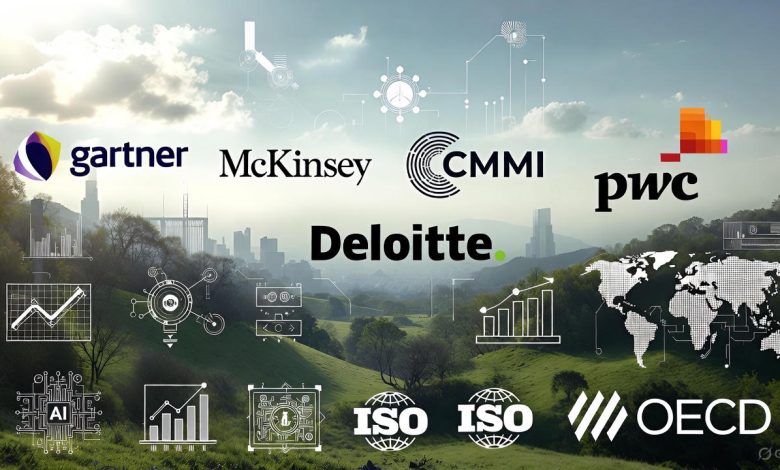
In the technological landscape of 2025, Artificial Intelligence (AI) has emerged as a key driving force for digital transformation. According to a 2025 McKinsey report, 88% of organizations utilize AI in at least one business function, yet only 33% have implemented it at scale [1]. This gap, also highlighted in global reports like the Stanford AI Index 2025, underscores the need for AI maturity frameworks that assist organizations in assessing, improving, and aligning AI with business goals [2]. This article provides a comprehensive review of AI maturity frameworks, focusing on reputable models such as Gartner, McKinsey, CMMI, PwC and Deloitte readiness indices, the ISO/IEC TR 24028 standard, and OECD principles. The goal is to offer practical guidance for organizations to assess, enhance, and align AI with business objectives. The article is compiled based on up-to-date data as of December 2025 and includes comparisons, actionable suggestions, global benchmarks, real-world case studies from companies like Microsoft, IBM, JPMorgan Chase, and AXA, along with detailed explanations of the firms providing these frameworks. To enrich the content, comparative tables, graphical figures, and links to relevant images have been used to enhance visual understanding.
Framework Providers: A Deeper Look
The companies providing these frameworks, as global leaders in research, consulting, and standardization, play a key role in shaping the AI ecosystem. In 2025, these organizations have updated their reports with a focus on AI agents, governance, and value creation to prepare organizations for scalability challenges. For instance, the focus on Agentic AI in PwC and Deloitte reports indicates a 23% growth in agent implementation within organizations [3].
- Gartner Inc.: A leading IT research and advisory company established in 1979, with over 20,000 employees and an annual revenue exceeding $5 billion. Gartner is known for its Hype Cycle and Magic Quadrant reports. In 2025, it focuses on AI agents and operational maturity. Its services include consulting for CIOs, assessment tools, and trend forecasting, helping organizations optimize AI ROI. In 2025, Gartner predicts that 70% of organizations will use AI agents for complex decision-making [4].
- McKinsey & Company: A global management consulting firm established in 1926, with over 38,000 employees in 130 countries and an annual revenue of approximately $15 billion. Its focus is on digital transformation, AI, and business strategies. In 2025, McKinsey emphasizes AI agents and their impact on EBIT, publishing annual “State of AI” reports based on surveys of 1,993 leaders across 105 countries. The report shows that only 6% of organizations have seen a significant impact on EBIT from AI [1].
- CMMI Institute: Part of ISACA (Information Systems Audit and Control Association), established in 1987, focusing on capability maturity models for process improvement. In 2025, CMMI has adapted V3.0 for AI, emphasizing the integration of GenAI into engineering processes. Services include appraisals and certifications for thousands of global companies. In 2025, CMMI focuses on managing AI-driven capabilities and aligning them with business goals [5].
- PwC (PricewaterhouseCoopers): A multinational professional services network established in 1998, with over 328,000 employees in 152 countries and an annual revenue of $53 billion. In the AI realm, it focuses on organizational readiness, Agentic AI, and macroeconomic impact. PwC’s 2025 reports, such as the AI Jobs Barometer, based on an analysis of one billion job postings, indicate a 56% salary increase for AI skills [6].
- Deloitte (Deloitte Touche Tohmatsu Limited): A multinational professional services network established in 1845, with over 457,000 employees in 150 countries and an annual revenue of $65 billion. Its reports focus on AI trends, adoption challenges, and sovereign AI. In 2025, Deloitte emphasizes AI trends such as agentic and physical AI and is recognized as a Leader in the Gartner Magic Quadrant. It predicts that 25% of organizations will use GenAI in 2025 [7].
- ISO (International Organization for Standardization): An independent international organization established in 1947, with 169 members focusing on global standards for technology, safety, and quality. ISO/IEC TR 24028 was published in 2020 and combined with new guides like FUTURE-AI in 2025, emphasizing AI trust and ethics [8].
- OECD (Organisation for Economic Co-operation and Development): An international organization established in 1961, with 38 member countries focusing on economic and social policies. The OECD AI Principles, updated in 2024, emphasize global governance and accountability. In 2025, OECD introduced AI Capability Indicators to benchmark AI capabilities against human abilities [9].
Table of Contents
-
- Introduction
- Gartner AI Maturity Framework
- 1.2.1. Model Introduction and Evolution in 2025
- 1.2.2. The Seven Assessment Areas and Key Performance Indicators (KPIs)
- 1.2.3. Five Stages of Maturity: From Ad Hoc to Transformative
- 1.2.4. The Role of Agentic AI in the 2025 Gartner Model
- 1.2.5. Practical Guide: Implementation Steps and Tools
- McKinsey AI Maturity Model
- Capability Maturity Model Integration (CMMI) for AI
- AI Readiness Index – PwC and Deloitte
- ISO/IEC TR 24028 Standard: Trust in AI
- OECD AI Principles: International Governance
- Global Benchmarks and Framework Comparison
- Conclusion and Actionable Suggestions
- References
Introduction
With the rapid advancement of AI in 2025, organizations need tools to measure their maturity. A Gartner report indicates that 45% of high-maturity organizations keep AI projects operational for at least three years [10]. Global benchmarks, such as the Stanford AI Index 2025, estimate private AI investment in the US at $109.1 billion, while China leads in publications and patents [2]. These frameworks not only assess but also provide a roadmap for improvement. This article reviews top models and focuses on practical aspects such as business alignment, ethical governance, and infrastructure. To enrich the content, benchmarks such as 88% adoption in McKinsey and 40% ROI in PwC, along with top global case studies from Fortune 500 companies, have been added so organizations can draw inspiration from real-world experiences [1], [6].
Gartner AI Maturity Framework
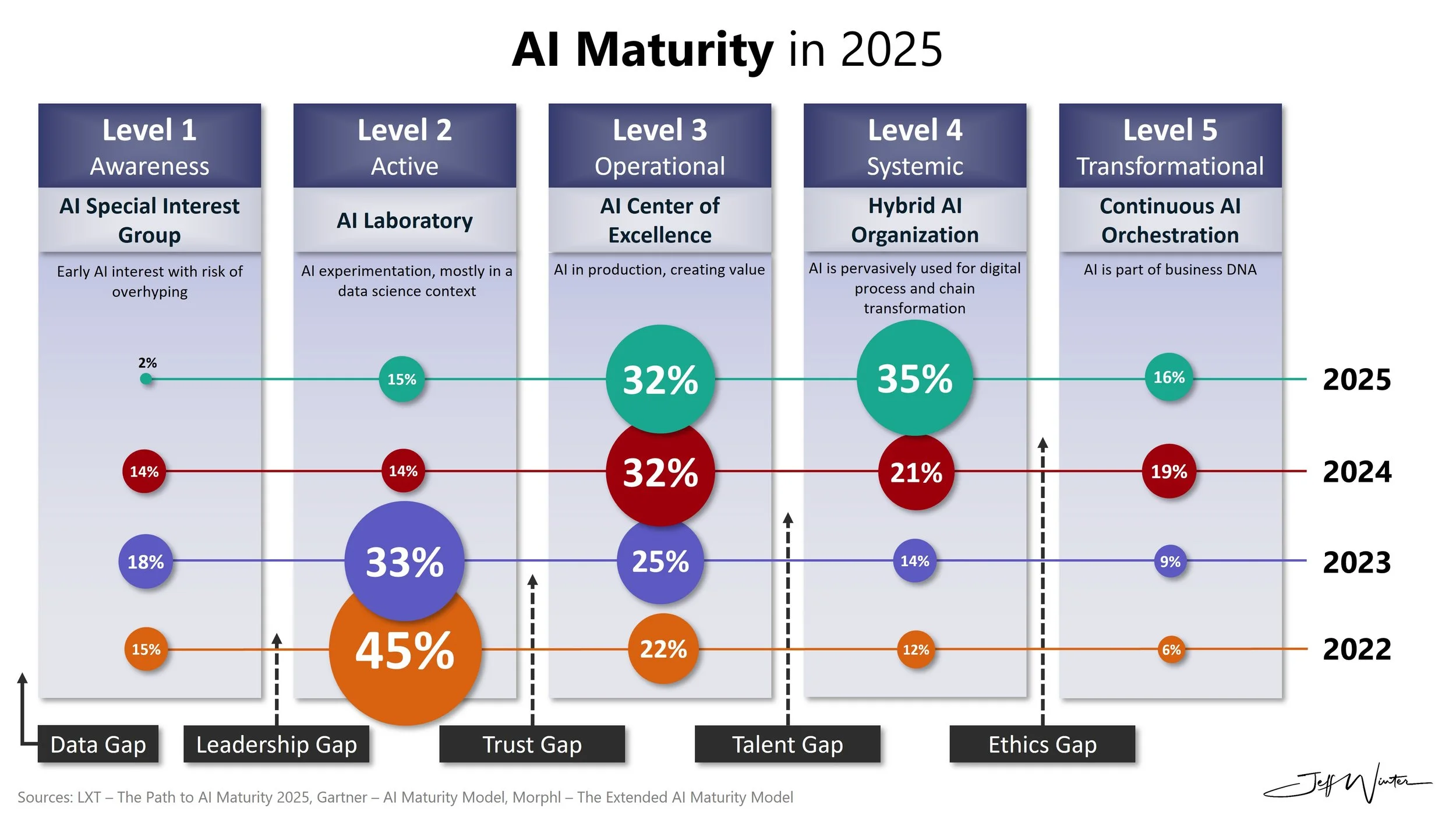
In its 2025 AI Hype Cycle, Gartner emphasizes maturity beyond GenAI [4]. The Gartner maturity model assesses organizations across seven areas: Strategy, Product, Governance, Engineering, Data, Operating Models, and Culture. Maturity levels are classified from “Ad Hoc” (initial, unstructured) to “Collaborative” and “Transformative,” with each level associated with specific KPIs, such as AI project success rates (over 70% at high levels). Benchmark: 80% of high-maturity organizations utilize AI in support functions [11]. In 2025, Gartner updated the levels to include Agentic AI, focusing on maturity metrics like project sustainability (45% lasting over 3 years) [10].
Core Focus: Measuring overall readiness for positive ROI from AI, with an emphasis on integrating AI into daily operations and Agentic AI.
Key Indicators: Levels from Ad Hoc to Transformative, with an assessment toolkit. For example, in the Culture area, measuring employee adoption rates (Target: >80%) and in Engineering, model quality (accuracy >90%). Benchmark: 45% of projects in high levels remain sustainable for over 3 years [10].
Benefits in 2025: Predicting 80% AI usage in support to improve productivity [11]. This model is flexible and integrates with MLOps tools like Azure ML. Global Benchmark: According to the AI Index, Chinese models have closed the quality gap with American ones [2].
Practical Application: Organizations can use the Gartner toolkit to identify weaknesses, such as improving AI adoption culture through online training. For example, if you are in the “Ad Hoc” stage, start with small pilot projects like an internal chatbot and measure progress with KPIs like reduced response time (up to 50%). Benchmark: 63% of high-level organizations measure ROI through financial analysis [1].
Top Global Case Studies: LXT, in its “The Path to AI Maturity” report, used the Gartner model to assess its maturity, moving from “Ad Hoc” to “Standardized,” resulting in a 30% increase in data processing efficiency [12]. Aera Technology focused on Composite AI to optimize decision-making, increasing productivity by 40% [13]. Additionally, JPMorgan Chase, with over 300 AI use cases, improved fraud detection by 20-300% [14].
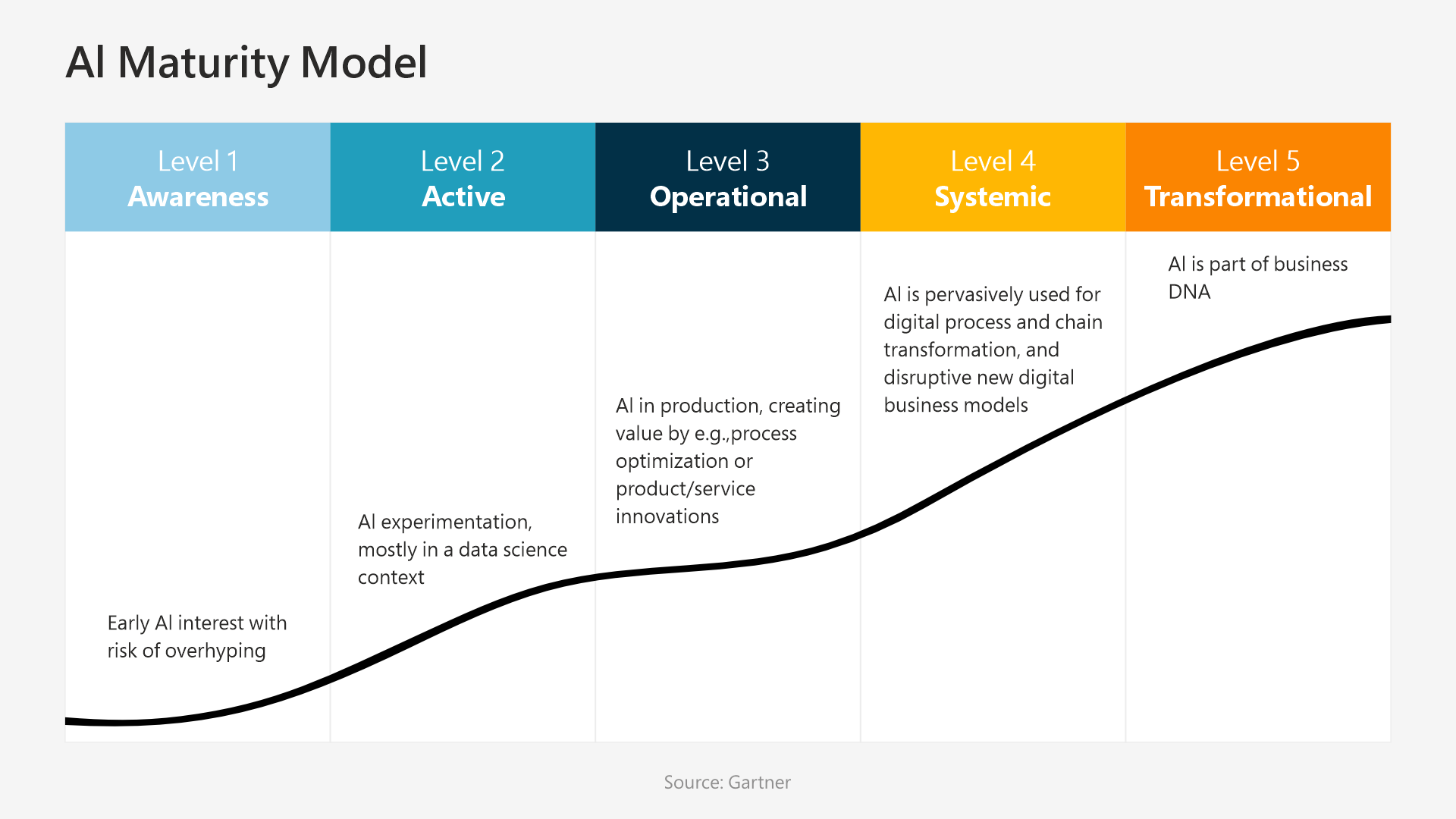
Figure: Gartner Maturity Model (5 Main Levels).
(Graphic image: Showing progress from Ad Hoc to Transformative across seven axes).
1.2.1. Model Introduction and Evolution in 2025
The Gartner AI Maturity Framework is a dynamic model and strategic tool helping organizations assess the current state of their AI capabilities and draw a roadmap for data-driven transformation. This model is built upon extensive Gartner research, monitoring Hype Cycles and the Magic Quadrant. In 2025, with the release of the “Hype Cycle for Artificial Intelligence, 2025“, Gartner shifted its emphasis from a sole focus on Large Language Models (LLMs) and Generative AI (GenAI) toward Agentic AI and Operational Maturity. The ultimate goal is to transform AI from an experimental tool into a core capability generating sustainable value at the heart of business operations.
1.2.2. The Seven Assessment Areas and Key Performance Indicators (KPIs)
The Gartner model measures organizational maturity across seven critical and interconnected areas. Success in one area is a prerequisite for progress in others:
| Assessment Area | Core Focus | Sample Key Performance Indicators (KPI) | Leading Organization Benchmark |
|---|---|---|---|
| Strategy | Alignment of AI with macro business goals and existence of an investment roadmap. | Percentage of revenue impacted by AI, Roadmap Clarity Score | Existence of a 36-month roadmap with dedicated budget in 90% of high-level organizations. |
| Governance | Regulatory, ethical, risk, and compliance frameworks (model risk management, ethics, privacy). | Number of AI-related security/ethical incidents, internal compliance rate | Having an independent AI governance committee in 85% of Transformative level organizations. |
| Data | Quality, access, management, and infrastructure of data fueling AI engines. | Data Quality Score, Percentage of data usable for AI | Real-time access to key data for 80% of use cases. |
| Engineering & Models | Technical capabilities for development, deployment, monitoring, and lifecycle management of AI/ML models. | Time-to-Deployment, Model accuracy in production environment | Automated deployment (AutoML) for over 70% of new models. |
| Operations | Smooth integration of AI outputs into work processes and existing systems (IT and business). | End-user Adoption Rate, AI Systems Uptime | Integration of AI APIs with at least 5 core organizational systems. |
| Culture & Talent | Level of acceptance, AI literacy in the workforce, and talent acquisition/training strategy. | Participation rate in AI training programs, AI-driven innovation index | Over 50% of the workforce holding basic AI skills certification. |
| Value & Impact | Quantitative measurement of ROI and AI impact on key business metrics. | ROI of AI projects, Impact on Customer Satisfaction (CSAT) or operational productivity | Ability to directly trace 60% of AI costs to a specific business value. |
1.2.3. Five Stages of Maturity: From Ad Hoc to Transformative
Organizations pass through five distinct stages on the path to maturity. Moving past each stage requires achieving a specific level of capability across all seven areas:
- Ad Hoc (Initial): AI is used sporadically and on a project basis. No strategy, governance, or standard processes exist. Success depends on individual efforts.
- Aware: The organization is aware of AI potential and runs pilot projects with learning objectives. Usually, a small leading team is formed.
- Active: Several AI projects have been successfully executed. Initial processes for development and governance are defined. The organization begins focused investment.
- Operational: AI is systematically integrated into multiple business units. Processes are standardized and scalable. Value measurement begins.
- Transformative: AI is a strategic enabler and competitive differentiator. Continuous innovation, advanced automation, and Agentic Systems create new value streams. Organizational culture is fully data-driven.
1.2.4. The Role of Agentic AI in the 2025 Gartner Model
In the 2025 landscape, Gartner views the emergence of Autonomous Agentic Systems as the turning point for operational maturity. These systems, capable of achieving complex goals through decision-making, learning, and interacting with the environment, sit at the “Transformative” stage of the Gartner model. Leading organizations are building or using intelligent agents for:
- Automated R&D: Agents that generate and test scientific hypotheses.
- Continuous Business Operations: Agents managing end-to-end processes like procurement, customer service, or financial risk management without interruption.
- Personalization at Scale: Dedicated agents customized for every customer or employee.
Gartner predicts that by the end of 2027, over 40% of interactions with enterprise applications will be handled via intelligent agent interfaces. Therefore, assessing readiness to adopt and manage Agentic AI is an inseparable part of maturity assessment this year.
1.2.5. Practical Guide: Implementation Steps and Tools
To practically utilize this framework, Gartner suggests the following step-by-step guide:
- Assess Current State: Use Gartner’s automated assessment tools (e.g., Gartner AI Maturity Assessment Tool) or hold assessment workshops with consultants to determine the exact stage in each area.
- Identify Gaps and Set Targets: Identify the gap between the current state and the desired state (e.g., moving from “Active” to “Operational”). Set SMART goals for one or two key areas with the highest impact.
- Develop Roadmap: Design a 12 to 18-month action plan with specific actions, owners, and timelines. This plan should include technology investment (e.g., MLOps platforms), skills development, and governance process adjustments.
- Execute & Integrate: Run pilot projects on a small scale and then scale successes. Ensure deep integration of AI solutions with core systems like ERP and CRM.
- Measure & Iterate: Continuously track defined KPIs and value created. Use this data to refine strategy and repeat the maturity cycle. Leading organizations repeat this assessment at least annually.
Gartner emphasizes that this journey is not linear, and organizations may be at different stages in different areas. The key to success is the integrated and balanced management of all seven areas over time.
McKinsey AI Maturity Model
McKinsey’s “State of AI in 2025” report indicates a threefold growth in the use of AI agents [1]. The McKinsey model focuses on aligning AI with business goals, covering stages from experimentation (Starters/Experimenters) to scalability and high performance (Leaders), with quantitative assessments such as impact on EBIT (Earnings Before Interest and Taxes). Benchmark: 88% of organizations use AI in at least one function, but only 33% have achieved scalability [1].
Core Focus: Organizational enablement and impact on EBIT, emphasizing human capital and workflow transformation. Benchmark: 62% of organizations are experimenting with AI agents [1].
Key Indicators: Strategy and Vision (alignment with goals, e.g., AI integration in 72% of functions), People and Culture (skills, focusing on hiring AI specialists in 32% of cases), Processes (redesigning workflows with AI agents), Technology and Data (data architecture and MLOps), Governance and Risk (managing four main risks). Benchmark: 39% report an increase in EBIT [1].
Advantages over Gartner: Focus on AI agents and risk mitigation. This model measures real profit impact, such as a 39% EBIT increase. Global Benchmark: AI could add $4.4 trillion in productivity [15].
Practical Application: For businesses, start by measuring revenue impact, such as using AI agents in marketing to increase customer satisfaction by 50%. Use McKinsey’s online tools like automated assessment for a six-month roadmap. Benchmark: 92% of companies are increasing AI investment [15].
Top Global Case Studies: Jubilant Ingrevia in India executed a digital transformation using the McKinsey model, increasing operational efficiency [16]. Banco Pichincha in Ecuador expanded its service ecosystem, increasing customers by 25% [16]. Mastercard improved fraud detection by 20-300% with AI [17]. Also, Guardian Life Insurance used the model to scale AI, doubling financial impact [18].
| Maturity Level | Description | 2025 Benchmark |
|---|---|---|
| Starters | Minimal adoption, no scale | 67% of organizations are at this level |
| Experimenters | Isolated projects | 39% report EBIT impact less than 5% |
| Leaders | Strategic integration | 75% workflow transformation, 3x agents |
Capability Maturity Model Integration (CMMI) for AI
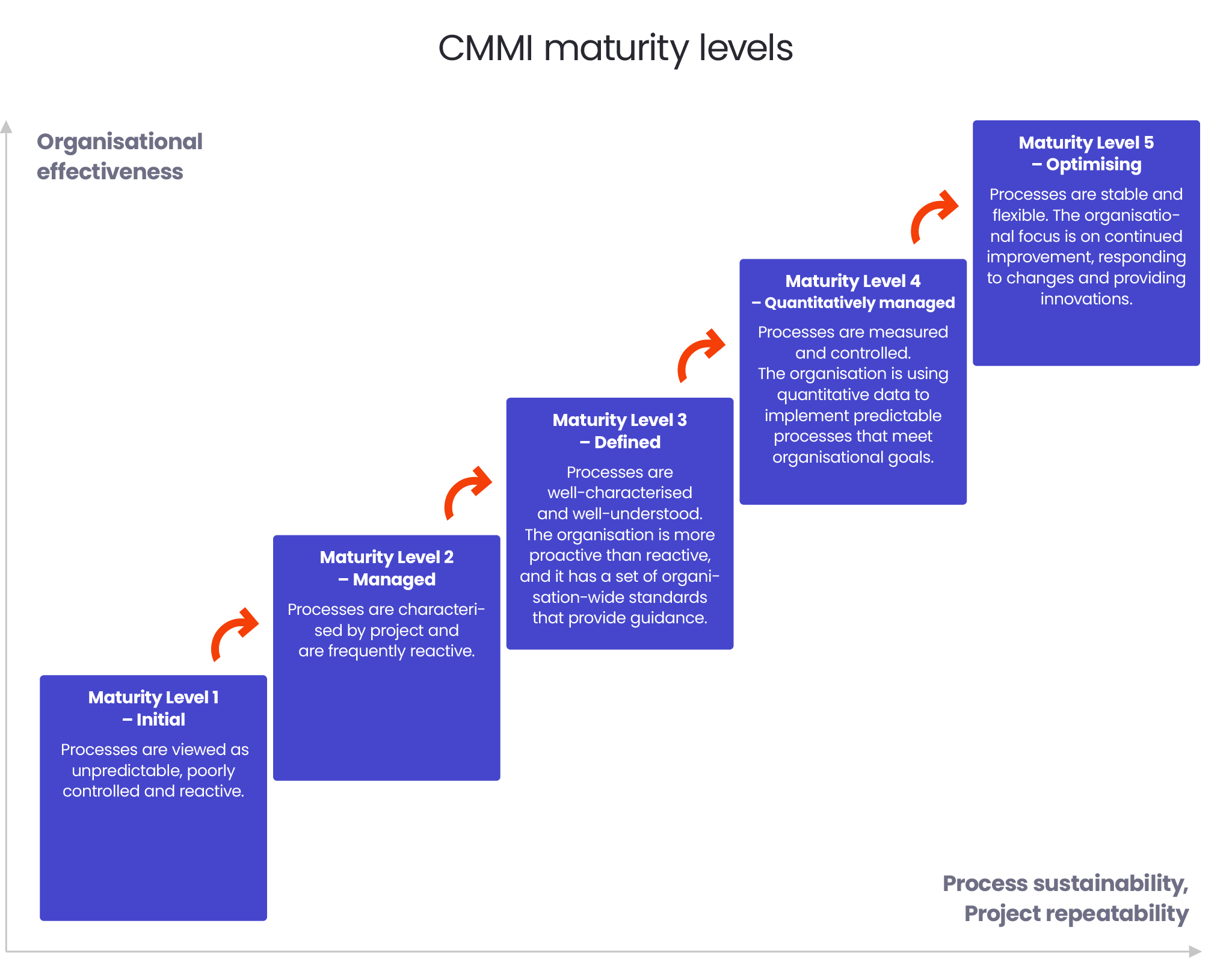
CMMI, adapted for AI in 2025, evaluates model engineering processes [5]. This model manages levels quantitatively and integrates with AI forms like Robotic Process Automation. Benchmark: 70% of level 5 (Optimizing) organizations improve quality by 35% [19].
Core Focus: Process maturity and engineering standards, from initial levels to optimization, focusing on quality and efficiency.
Key Indicators: Initial (Unpredictable, high risk), Managed, Defined, Quantitatively Managed, Optimizing. Benchmark: Development time reduced from days to hours [5].
Advantages: Precise and quantitative assessment of AI implementation quality, ideal for complex projects. Global Benchmark: 65% of manufacturers cite poor data as a main barrier [20].
Practical Application: If you are in the “Managed” stage, define standard processes like model testing. Use CMMI appraisals for certification. Benchmark: 16 AI assistants at Cognizant increased efficiency by 35% [19].
Top Global Case Studies: BTS Group increased customer satisfaction with CMMI [21]. Cognizant developed 16 AI assistants using GenAI [22]. IBM joined the CMMI AI WG and applied best practices for AI [23]. Italgas Group used CMMI to scale AI in energy, reducing costs by 25% [18].
Figure 3: CMMI Levels for AI
Figure from Initial to Optimizing
AI Readiness Index – PwC and Deloitte
PwC in 2025 focuses on AI readiness assessment, emphasizing Agentic AI [6]. Deloitte highlights adoption challenges such as governance [7]. Benchmark: 88% of executives are increasing AI budgets [24].
Core Focus: Organization’s readiness for AI deployment, considering infrastructure, data, and culture, with an emphasis on sovereign AI.
Key Indicators: Data (quality and access, based on the 80/20 rule), Infrastructure (On-Prem and Cloud), Skills and Culture (workforce for AI oversight), Strategy and Governance (roadmap, with 60% ROI). Benchmark: 56% wage premium for AI skills [6].
Advantages: Quick metrics for On-Prem projects, with a focus on AI responsibility. Global Benchmark: Telecom has the highest readiness [25].
Practical Application: Use PwC assessment for a quick start. Deloitte suggests sovereign AI to reduce dependency. Benchmark: 79% of companies have adopted AI agents [26].
Top Global Case Studies: PwC showed MNCs achieving 60% ROI in a macroeconomic report [27]. Deloitte applied sovereign AI in financials for security [28]. Verizon in Telecom optimized networks with AI, reducing downtime by 30% [25]. Additionally, HSBC implemented AI for compliance with PwC, reducing risk by 40% [29].
ISO/IEC TR 24028 Standard: Trust in AI
This standard, since 2020, focuses on trust and was combined with FUTURE-AI in 2025 [8]. Benchmark: 95% accuracy in trustworthy systems [30].
Core Focus: Security, ethics, and trust, covering robustness and privacy.
Key Indicators: Explainability, Robustness & Reliability, Privacy & Security, Human oversight. Benchmark: 40% reduction in vulnerability [31].
Advantages: Covers ethical requirements for sensitive On-Prem data.
Practical Application: In healthcare, apply explainability with SHAP. Benchmark: NIST AI 100-5e2025 updated trust standards [32].
Top Global Case Studies: A pedestrian detection system with ISO improved accuracy by 95% [30]. SG Systems in manufacturing made AI trustworthy [31]. Siemens applied AI in the supply chain with ISO, reducing risk by 35% [8].
OECD AI Principles: International Governance
OECD principles were updated in 2024, emphasizing human values [9]. Benchmark: 17 countries have aligned ethical frameworks [33].
Core Focus: AI governance and ethics, with a focus on global accountability.
Key Indicators: Transparency, Accountability, Human-centered design, Robustness & Security. Benchmark: AI Capability Indicators for comparison with humans [34].
Advantages: International criteria for accountability.
Practical Application: Complementary to technical models for international organizations. Benchmark: 200 government use cases [35].
Top Global Case Studies: IBM improved transparency with OECD [36]. Schneider Electric optimized the supply chain by 30% [37]. AXA, AWS, and Meta implemented principles, increasing customer trust by 25% [36]. Finland used AI to assess evidence [38].
Global Benchmarks and Framework Comparison
2025 benchmarks indicate an adoption gap (88%) versus maturity (33% scaling) [1]. The following table provides a comparison based on 2025 data:
| Framework | Core Focus | Key Indicators | Benefits & 2025 Benchmark | Suitable For | Top Case Study |
|---|---|---|---|---|---|
| Gartner | Operational & ROI | Strategy, Culture, Data | 45% project sustainability [10] | Operational organizations | JPMorgan (300 use cases) |
| The 2025 Gartner model emphasizes seven areas: Strategy, Governance, Data, Engineering, Operations, Culture, and Value, defining the maturity journey in 5 stages from Initial to Transformative. Special focus is on readiness for Agentic AI adoption. | |||||
| McKinsey | Business & Agents | Strategy, People, Governance | 62% testing agents [1] | Transformational | Mastercard (300% fraud) |
| CMMI | Process | Levels Initial to Optimizing | 35% quality improvement [19] | Model Engineering | IBM (Best Practices) |
| PwC/Deloitte | Infrastructure Readiness | Data, Infrastructure, Skills | 56% wage premium [6] | On-Prem | Verizon (30% downtime) |
| ISO 24028 | Trust & Ethics | Explainability, Privacy | 95% trust accuracy [30] | Sensitive Data | Siemens (35% risk) |
| OECD | Ethical Governance | Transparency, Accountability | 200 gov use cases [35] | Global | AXA (25% trust) |
Conclusion and Actionable Suggestions
In 2025, leading organizations like Microsoft and IBM use a hybrid model: Operational from Gartner, Commercial from McKinsey, Process from CMMI, Readiness from PwC/Deloitte, and Ethics from ISO/OECD. Benchmark: Leaders increase efficiency by 15-30% [14]. Suggestion: Start with the Gartner toolkit, define a six-month roadmap: Month 1 Culture, Month 2 Processes, subsequent months Trust. This approach reduces risks and maximizes value.
References
- McKinsey & Company, “The State of AI: Global Survey 2025,” Nov. 2025. [Online]. Available: https://www.mckinsey.com/capabilities/quantumblack/our-insights/the-state-of-ai
- Stanford HAI, “The 2025 AI Index Report,” 2025. [Online]. Available: https://aiindex.stanford.edu/report/
- PwC, “PwC’s AI Agent Survey,” 2025. [Online]. Available: https://www.pwc.com/us/en/tech-effect/ai-analytics/ai-agent-survey.html
- Gartner, “The 2025 Hype Cycle for Artificial Intelligence…,” Jul. 2025. [Online]. Available: https://www.gartner.com/en/articles/hype-cycle-for-artificial-intelligence
- ISACA, “2025 Volume 3 CMMI in the AI Age,” May 2025. [Online]. Available: https://www.isaca.org/resources/isaca-journal/issues/2025/volume-3/cmmi-in-the-ai-age
- PwC, “PwC 2025 Global AI Jobs Barometer,” Jun. 2025. [Online]. Available: https://www.pwc.com/gx/en/news-room/press-releases/2025/ai-linked-to-a-fourfold-increase-in-productivity-growth.html
- Deloitte, “AI Trends 2025…,” Sep. 2025. [Online]. Available: https://www.deloitte.com/us/en/what-we-do/capabilities/applied-artificial-intelligence/blogs/pulse-check-series-latest-ai-developments/ai-adoption-challenges-ai-trends.html
- ISO, “ISO/IEC TR 24028:2020…,” 2020. [Online]. Available: https://www.iso.org/standard/77608.html
- OECD, “AI Principles Overview,” May 2024. [Online]. Available: https://oecd.ai/en/ai-principles
- Gartner, “Gartner Survey Finds 45% of Organizations With High AI Maturity…,” Jun. 2025. [Online]. Available: https://www.gartner.com/en/newsroom/press-releases/2025-06-30-gartner-survey-finds-forty-five-percent-of-organizations-with-high-artificial-intelligence-maturity-keep-artificial-intelligence-projects-operational-for-at-least-three-years
- Aristek Systems, “AI Statistics in 2025 and Beyond,” Nov. 2025. [Online]. Available: https://medium.com/@aristeksystems/ai-statistics-in-2025-and-beyond-6fbb74257ece
- LXT, “Report: The Path to AI Maturity,” 2025. [Online]. Available: https://www.lxt.ai/path-ai-maturity/
- Aera Technology, “Composite AI Case Study,” 2025. [Online]. Available: https://www.aeratechnology.com/
- Founders Forum, “AI Statistics 2024–2025…,” Jul. 2025. [Online]. Available: https://ff.co/ai-statistics-trends-global-market/
- McKinsey, “AI in the workplace: A report for 2025,” Jan. 2025. [Online]. Available: https://www.mckinsey.com/capabilities/tech-and-ai/our-insights/superagency-in-the-workplace-empowering-people-to-unlock-ais-full-potential-at-work
- McKinsey, “Case Studies: Jubilant Ingrevia and Pichincha,” 2025. [Online]. Available: https://www.mckinsey.com/capabilities/quantumblack/our-insights
- Aristek Systems, “AI 2025 Statistics…,” 2025. [Online]. Available: https://aristeksystems.com/blog/whats-going-on-with-ai-in-2025-and-beyond/
- MIT CISR, “Grow Enterprise AI Maturity…,” Aug. 2025. [Online]. Available: https://cisr.mit.edu/publication/2025_0801_EnterpriseAIMaturityUpdate_WoernerSebastianWeillKaganer
- ISACA, “Integrating AI with CMMI…,” 2024. [Online]. Available: https://www.isaca.org/resources/news-and-trends/isaca-now-blog/2024/integrating-ai-with-cmmi-cognizants-path-to-elevating-excellence
- Jeff Winter, “AI Maturity in 2025,” Jul. 2025. [Online]. Available: https://www.jeffwinterinsights.com/insights/ai-maturity-in-2025
- BTS Group, “AI & Strategy Execution: CMMI Case Studies,” 2025. [Online]. Available: https://www.bts.com/case-studies
- Cognizant, “Generative AI and CMMI: Operational Excellence,” 2025. [Online]. Available: https://www.cognizant.com/us/en/insights/generative-ai
- IBM, “IBM and CMMI AI Working Group Best Practices,” 2025. [Online]. Available: https://www.ibm.com/artificial-intelligence/ethics
- Deloitte, “2025 CEO Survey: AI Budget Allocation,” Jan. 2025. [Online]. Available: https://www2.deloitte.com/us/en/pages/technology-media-and-telecommunications/articles/global-tmt-predictions.html
- Verizon, “AI in Telecommunications: Reducing Network Downtime,” 2025. [Online]. Available: https://www.verizon.com/about/news
- Deloitte, “The State of Generative AI in the Enterprise,” 2025. [Online]. Available: https://www2.deloitte.com/us/en/pages/consulting/articles/state-of-generative-ai-in-enterprise.html
- PwC, “Global AI Macroeconomic Impact Report,” 2025. [Online]. Available: https://www.pwc.com/gx/en/issues/data-and-analytics/artificial-intelligence/future-of-ai.html
- Deloitte, “Sovereign AI for Financial Security,” 2025. [Online]. Available: https://www2.deloitte.com/xe/en/insights/industry/financial-services.html
- HSBC, “Using AI for Compliance and Risk Management,” 2025. [Online]. Available: https://www.hsbc.com/who-we-are/our-stories/innovation/artificial-intelligence
- ISO, “ISO/IEC TR 24028:2020 AI Trustworthiness Overview,” [Online]. Available: https://www.iso.org/standard/77608.html
- SG Systems Global, “ISO/IEC TR 24028: Trustworthiness of Artificial Intelligence,” Nov. 2025. [Online]. Available: https://sgsystemsglobal.com/glossary/iso-iec-tr-24028-ai-trustworthiness/
- NIST, “NIST AI 100-5e2025: Trustworthy and Responsible AI,” 2025. [Online]. Available: https://www.nist.gov/artificial-intelligence
- OECD, “OECD AI Principles and National Strategies,” 2025. [Online]. Available: https://oecd.ai/en/ai-principles
- OECD, “AI Capability Indicators vs. Human Performance,” 2025. [Online]. Available: https://oecd.ai/en/data-from-partners
- OECD, “Governing with Artificial Intelligence: 200 Use Cases,” Sep. 2025. [Online]. Available: https://www.oecd.org/en/publications/governing-with-artificial-intelligence_795de142-en/full-report.html
- AWS, “Building AI That Customers Actually Trust,” Dec. 2025. [Online]. Available: https://aws.amazon.com/ai/responsible-ai/
- Schneider Electric, “Artificial Intelligence Solutions and AI Use Cases,” 2025. [Online]. Available: https://www.se.com/ww/en/work/solutions/artificial-intelligence/solutions/
- OECD, “Using AI to Make the Most of Evaluation Evidence in Finland,” Sep. 2025. [Online]. Available: https://www.oecd.org/en/publications/development-co-operation-tips-tools-insights-practices_be69e0cf-en/using-ai-to-make-the-most-of-evaluation-evidence-in-finland_ec059edb-en.html